
Why Data-Driven Decision Making is Reshaping the Insurance Industry
May 27, 2025
In an increasingly complex and competitive environment,data-driven decision making is rapidly transforming the way insurance companies operate. The convergence of advanced analytics, big data, and business intelligence (BI) tools has elevated insurers’ capabilities to assess risk, improve operational efficiency, and deliver tailored customer experiences. Especially across North America, including the USA and Canada, insurers are embracing data strategies not just as an enhancement—but as a business imperative.
This evolution is particularly relevant now as insurers navigate shifting regulations, customer expectations, and macroeconomic pressures. With growing interest from regulatory bodies like the National Association of Insurance Commissioners (NAIC) in the U.S. and the Office of the Superintendent of Financial Institutions (OSFI) in Canada, insurers must simultaneously innovate and stay compliant.
From Intuition to Information: The Shift to Data-Driven Decision Making
Traditionally, underwriting and pricing decisions in insurance relied heavily on historical data and actuarial assumptions. But as market volatility, climate risks, and customer behavior patterns evolve rapidly, these methods have become less effective in isolation. Enter data-driven decision making in insurance—a systematic approach that leverages real-time data, predictive models, and artificial intelligence to drive business strategy.

Today, insurers are collecting data from diverse sources including:
- Wearables and IoT devices (e.g., telematics in auto insurance)
- Social media and digital footprints
- Public health records and credit scores
- Satellite imagery for property risk assessmen
This influx of data has made analytics for insurance companies in the USA and beyond not only more robust but also more nuanced. With this, decisions related to claims management, fraud detection, and even customer service are becoming faster, smarter, and more accurate.
The Role of Business Intelligence (BI) in Insurance
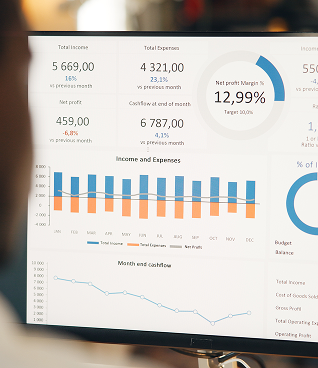
The integration of business intelligence in insurance has enabled companies to convert vast amounts of raw data into actionable insights. BI platforms consolidate data from disparate systems and visualise performance indicators across departments, helping executives make informed decisions in real time.
For example, U.S.-based carriers use BI dashboards to:
- Monitor loss ratios by line of business and geography
- Track agent productivity and policy conversions
- Detect anomalies in claims for early fraud signals
- Evaluate risk portfolios under varying economic scenarios
In Canada, insurers are leveraging BI for similar operational gains. One notable trend is the use of BI tools to comply with OSFI’s capital adequacy and risk management frameworks, which require detailed data aggregation and reporting.
The 2022 OSFI guideline B-10 on Third-Party Risk Management, for instance, has prompted Canadian insurers to adopt stronger BI capabilities to assess and report vendor-related exposures—something traditional systems struggled to do efficiently.
Regulatory Alignment: Data, Analytics & Compliance
Regulators across North America are beginning to recognize the potential—and the risks—of widespread data use in insurance.
United States: NAIC’s Role
The NAIC is increasingly focused on how insurers utilize data analytics in underwriting and marketing. In 2023, it launched discussions around ethical AI use and algorithmic accountability, signaling future regulatory scrutiny on opaque or discriminatory model behaviors.
For insurers operating in the U.S., this means data-driven strategies must align with fairness, transparency, and consumer protection principles. Carriers using predictive analytics must now be ready to explain how their models work, what data they rely on, and how they avoid bias, particularly in auto and life insurance pricing.
Canada: OSFI’s Oversight
In Canada, OSFI has taken a proactive stance on the responsible use of technology. The regulator’s expectations around model risk management, especially in the context of AI and machine learning, are pushing insurers to formalize their analytics governance. Insurers are now expected to establish model validation frameworks, assess data quality, and maintain audit trails for decisions derived from algorithms.
These compliance requirements are not hindrances—they are enablers. Insurers that proactively embed compliance into their analytics frameworks build trust, streamline audits, and avoid reputational risks.
Real-World Applications of Data-Driven Strategies
Let’s explore how data is driving real-world innovation in the insurance industry:
-
Predictive Underwriting
Instead of relying solely on questionnaires and medical exams, life and health insurers now use predictive analytics to assess risk. Data from prescription drug histories, lifestyle apps, and even wearable devices helps them issue policies faster with higher underwriting precision.
-
Dynamic Pricing
In auto insurance, telematics programs allow real-time monitoring of driving behavior. Companies like Progressive and Allstate in the U.S., and Intact in Canada, are offering dynamic pricing models that reward safe driving with lower premiums. These programs are possible only through sophisticated analytics for insurance companies in the USA and Canada.
-
Fraud Detection
Using anomaly detection and pattern recognition algorithms, insurers can flag suspicious claims before they are paid. This is particularly valuable in health and motor insurance, where fraudulent activities cost billions annually.
-
Catastrophe Modeling
With climate change accelerating natural disasters, property insurers are turning to geo-spatial analytics and AI models to estimate losses more accurately and prepare their portfolios accordingly. Satellite imagery and weather data are now central to catastrophe underwriting.
Conclusion: A Smarter, Fairer Future
Data-driven decision making in insurance is not a trend—it’s a transformative force that is reshaping underwriting, pricing, customer experience, and compliance. As BI and analytics for insurance companies in the USA and Canada mature, insurers must invest in infrastructure, talent, and ethical governance to maximize value while maintaining trust.
Regulators like NAIC and OSFI will continue to play a pivotal role in shaping responsible innovation. For insurers willing to embrace this future, the result is clear: better decisions, stronger risk management, and a more responsive, customer-centric insurance model.
Sources:
- McKinsey & Company (2021). Insurance 2030 – The Impact of AI on the Future of Insurance.
https://www.mckinsey.com/industries/financial-services/our-insights/insurance-2030-the-impact-of-ai-on-the-future-of-insurance - OSFI (2022). Guideline B-10: Third-Party Risk Management.
https://www.osfi-bsif.gc.ca/Eng/fi-if/rg-ro/gdn-ort/gl-ld/Pages/b10.aspx - NAIC (2023). AI and Big Data Working Group Reports.
https://content.naic.org/cmte_ex_ai_wg.htm - CLHIA (2022). Canadian Life and Health Insurance Facts
https://www.clhia.ca/web/CLHIA_LP4W_LND_Webstation.nsf/resources/FactsBook_2/$file/2022+CLHIA+Facts+Book.pd
Recent Articles



Archives:
- February 2026 (2)
- January 2026 (2)
- November 2025 (8)
- October 2025 (2)
- September 2025 (3)
- August 2025 (5)
- July 2025 (6)
- June 2025 (2)
- May 2025 (1)
- April 2025 (2)
- March 2025 (2)
- February 2025 (4)